
Evolutionary Game Theory: The Scientific Foundation of the Ownership Society
Walter Barry
September 2, 2026 · 9 min read
Evolutionary game theory studies how strategies for competing and cooperating spread through a population over time. Where classical game theory asks what a single rational player should do in one encounter, evolutionary game theory asks a different question: which strategies survive when the same game is played again and again, generation after generation? The strategies that persist — that cannot be displaced by a rival strategy once they are common — are called evolutionarily stable strategies, or ESS.
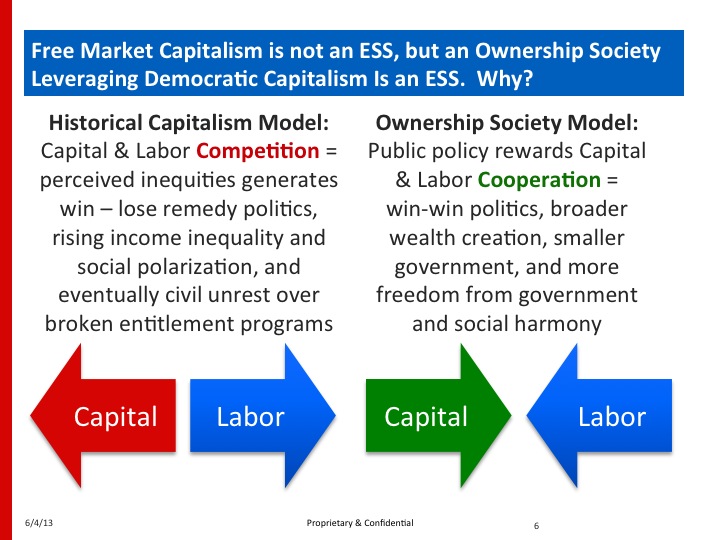
That idea is the scientific foundation of the Ownership Society framework argued throughout this site. An Ownership Society is man's next evolutionary mutation of free market capitalism, and it represents an evolutionarily stable socio-economic strategy to complement Representative Democracy as a political ESS.
Why the Prisoner's Dilemma matters for public policy
In classic game theory like a Prisoner's Dilemma, you have two parties who can compete or cooperate. If the payoff is greater to compete and defect first, both parties will defect. Two people have committed a crime and are interrogated separately. If they both admit to the crime, they can negotiate a plea agreement for a short sentence. If they both lie and are found guilty, they serve a long term. If one lies on the other, the defector may go free while the other serves jail time. Both parties are therefore motivated to defect in the hope of their best individual outcome — and both end up worse off.
Play that game once and defection wins. Play it repeatedly, with memory and reputation, and the calculus flips. This is the central insight of evolutionary game theory: repetition changes which strategy is stable.
The mechanisms that make cooperation stable
Evolutionary biologist Martin Nowak identified the conditions under which cooperation can evolve and hold: direct reciprocity, indirect reciprocity, kin selection, group selection, and network reciprocity. Each mechanism is a different way of ensuring the benefits of cooperating return to the cooperator often enough to outcompete defection.
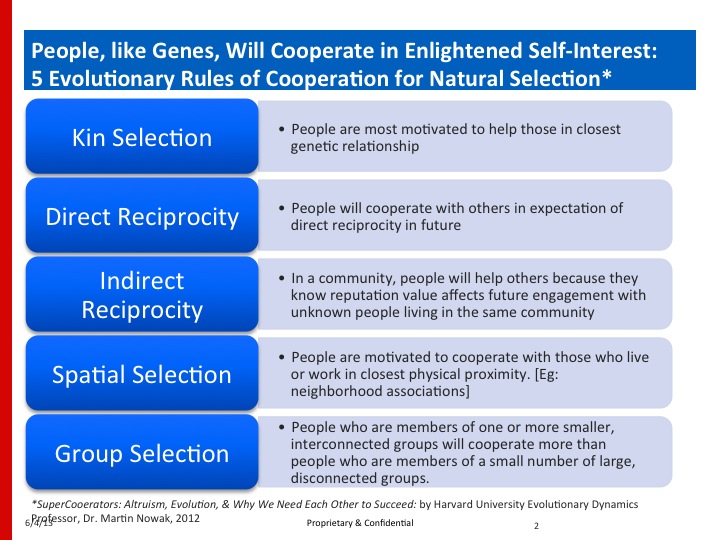
Direct reciprocity — the Golden Rule, formalized — is the mechanism most relevant to economic policy. I cooperate with you today because we will meet again tomorrow. The winning repeated-game strategies are forgiving and adaptive: win-stay, lose-shift. Expand what works, adapt what doesn't.
Capital and labor as an evolutionary game
Apply the framework to the socio-economic history of man. Capital and labor have competed for centuries in classic Darwinian struggle. Capital usually wins because it owns the asset and is more nimble. In game theory terms, capital is indifferent to cooperating or competing with labor, while labor is rewarded more by cooperating with capital than by competing with it — labor is dependent on capital and far less mobile.
But when labor competes to gain near-term advantage, capital loses and shifts its strategy: outsourcing jobs, relocating investment, automating production. Labor's defection triggers capital's defection, and both sides land in the low-payoff corner of the game. A century of remedy politics — correcting capital's wrongs after the fact — has never changed the underlying payoff matrix.
What an evolutionarily stable strategy requires
If defection is the stable outcome of the current game, then the game itself must change. Fiscal policy has to reward capital for cooperating with labor, so the joint payoff from cooperation exceeds what either side gains by defecting. Ownership does exactly that. When workers own a share of the fruits of their labor, labor's payoff and capital's payoff move together, and cooperation stops being altruism and becomes self-interest.
That is what makes an Ownership Society an ESS rather than a slogan. It does not depend on either side being generous. It survives because, once ownership is broadly distributed, no rival strategy — neither a purely extractive capitalism nor an entitlement society of perpetual dependence — can invade and do better.
Where to read the argument in full
The essays on this site develop each strand of the framework: the central thesis on how an Ownership Society evolves from free market capitalism; the winning evolutionary strategy applied to public policy making; direct reciprocity as the answer to inequality and exclusion from capitalism; and the fork in America's road between an entitlement society and an ownership society. Together they make the case that reducing income inequality, expanding freedom, and solving the fiscal deficit are not competing goals but the predictable payoff of a stable cooperative strategy.
Discussion
0 comments · Add a considered reply.