
Pillar guide
Evolutionary Game Theory
Evolutionary game theory is the study of which strategies survive when the same game is played, over and over, by whole populations. It replaces the lone rational calculator of classical game theory with something closer to reality: people, firms, and nations copying whatever has been paying off. It is also the scientific spine of the Ownership Society — the reason broad ownership is treated here as a durable arrangement rather than a slogan.
The four moving parts
- The game
- Any situation where your payoff depends on what other people do. Trade, wage bargaining, tax compliance, and treaty-making are all games in this sense.
- The strategy
- A rule of behavior — cooperate, defect, retaliate, forgive — that players inherit, imitate, or learn rather than calculate fresh each round.
- The payoff
- Not utility in the abstract but replication: strategies that do better spread, whether by genes, habit, corporate practice, or law.
- Evolutionarily stable strategy (ESS)
- A strategy that, once common in a population, cannot be displaced by a rare mutant strategy. ESS is the test any durable policy has to pass.
The Prisoner's Dilemma, and why it is not the end of the story
Two players each do better by defecting no matter what the other does — yet both end up worse off than if they had cooperated. Played once, defection is the stable answer. Played repeatedly, with memory and reputation, cooperation becomes the strategy that survives. Most of political economy is an argument about which of those two games we are actually in.
Five mechanisms that make cooperation stable
Martin Nowak catalogued the conditions under which cooperation can evolve and hold. Every workable institution leans on at least one of them.
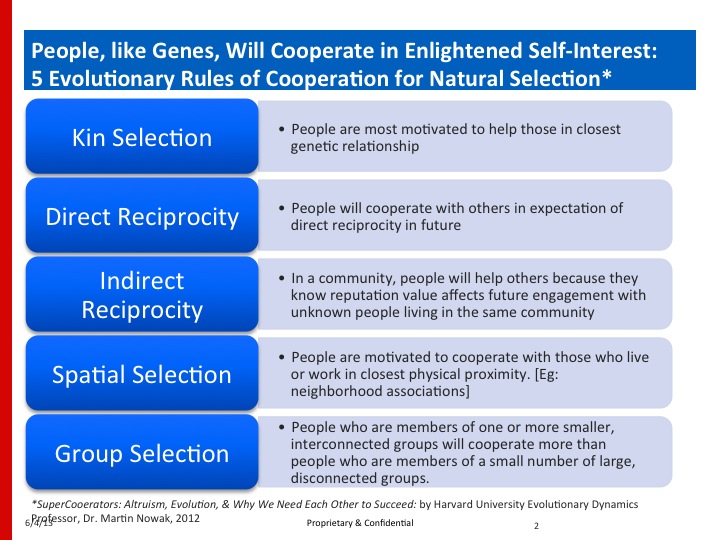
- 1Direct reciprocity. I help you because we will meet again. Tit-for-tat behavior turns a one-shot Prisoner's Dilemma into a repeated game where cooperation pays.
- 2Indirect reciprocity. I help you because others are watching. Reputation lets cooperation survive between strangers — the basis of credit, contracts, and brands.
- 3Spatial selection. Cooperators clustered together out-produce scattered defectors. Neighborhoods, firms, and supply chains all show this clustering effect.
- 4Group selection. Groups of cooperators outcompete groups of defectors, even when defectors do better inside any single group.
- 5Kin selection. Shared genes make sacrifice pay. The narrowest mechanism, and the one modern institutions rely on least.
Capital and labor as a repeated game
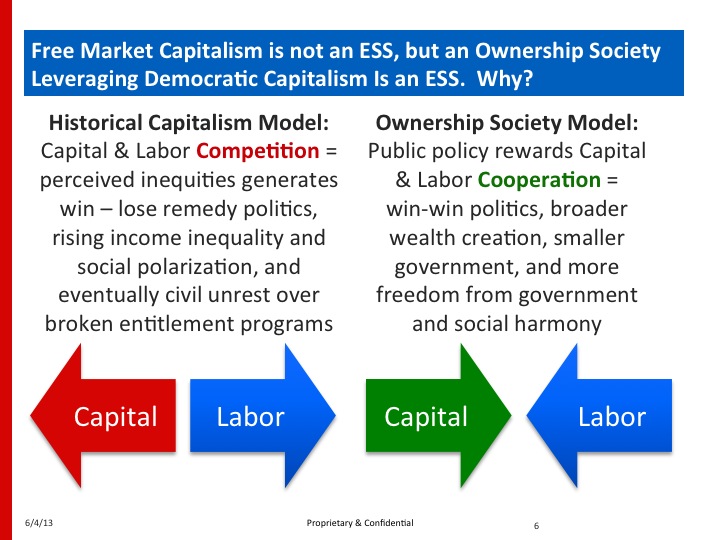
Treat capital and labor as two players locked into an indefinitely repeated game and the policy question changes shape. Wage fights are single rounds. Ownership changes the payoff matrix itself: when workers hold assets, the cooperative outcome is also the self-interested one for both sides. That is what makes broad ownership a candidate for an evolutionarily stable strategy instead of a temporary redistribution.
Go deeper
Evolutionary Game Theory: The Scientific Foundation of the Ownership Society
The full essay works through the Prisoner's Dilemma, Nowak's conditions, and the ESS test applied to American fiscal and labor policy.
Read the full essayCommon questions
What is evolutionary game theory?
Evolutionary game theory studies how strategies spread through a population over time based on the payoffs they earn, rather than assuming perfectly rational one-shot decisions. It was developed by John Maynard Smith and George Price in the 1970s and is now used in biology, economics, and public policy.
How is it different from classical game theory?
Classical game theory asks what a rational player should do once. Evolutionary game theory asks which strategies survive when the game is played over and over by populations that copy what works.
What is an evolutionarily stable strategy?
An evolutionarily stable strategy (ESS) is one that resists invasion: if nearly everyone plays it, no rare alternative strategy earns a higher payoff, so the arrangement holds.
Why does evolutionary game theory matter for public policy?
Policies are strategies played repeatedly by millions of people. A policy that only pays off while one side loses invites defection and gets undone. A policy that pays off for cooperators is evolutionarily stable — it lasts.
New here? Start with the Ownership Society thesis, browse all essays, or read about Walter Barry.